










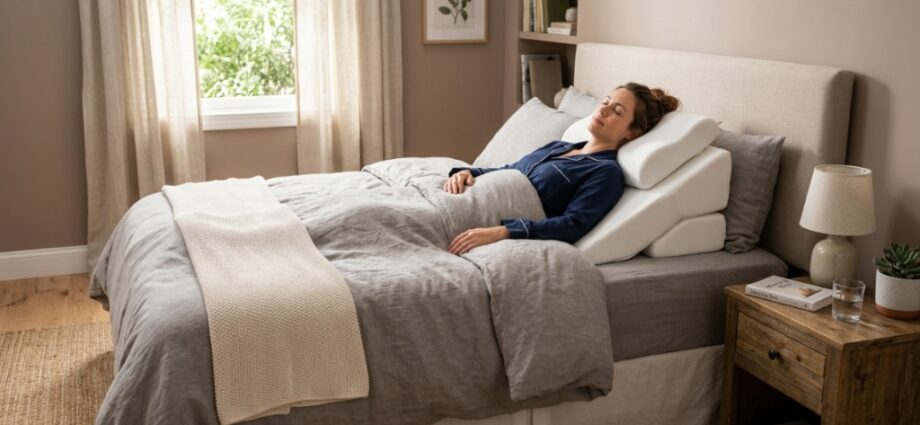
Waking up with a sore neck, acid reflux, or that nagging feeling of congestion is exhausting. You bought an adjustable wedge pillow to fix it, but if it isn’t set up correctly, you’ll end up fighting the foam instead of sleeping on it. The truth is, a wedge pillow isn’t a one-size-fits-all prop; it’s a precision tool. Getting the angle, position, and support layers right transforms your bed into a therapeutic sleep station. In this guide, I’ll walk you through a practical, step-by-step process for the perfect adjustable wedge pillow setup for sleep, ensuring you finally get the rest your body craves.
What Is the Ideal Angle for Your Wedge Pillow?
The ideal angle depends entirely on your health goal, but most users need a 15 to 30-degree incline. For general comfort and back support, 15 degrees works well. For acid reflux, you often need 20 to 30 degrees to keep stomach acid down. For breathing issues, a higher angle is best, but too steep can cause lower back pain.
Finding the “Sweet Spot” for Reflux and Digestion
If you suffer from GERD or acid reflux, the goal is to use gravity to your advantage. A low angle won’t do the job. You need the esophagus to sit above the stomach. Using your adjustable wedge, set it to the highest comfortable setting that doesn’t cause you to slide down during the night. Start at 20 degrees for three nights, then adjust to 25. This gradual ramping helps your body adapt.
Choosing the Right Angle for Snoring and Sleep Apnea
For snoring, a moderate 15 to 20-degree incline helps keep your airway open by preventing the tongue from collapsing backward. For mild sleep apnea (only if recommended by a doctor), a higher angle of 30 degrees is often used. Be cautious; a very high incline can sometimes put pressure on the hips, so a pillow under the knees is essential here.
Adjusting the Wedge for Back Pain Relief
When using a wedge for back pain, you aren’t just lifting your head. You are elevating your upper body to reduce pressure on the spine. A 15-degree angle is usually optimal for this. If the wedge feels too aggressive on your tailbone, lower it. The goal is a straight, uncompressed spine, not a folded torso.
How Do You Position the Wedge Pillow Correctly on the Bed?
Place the wedge in the exact center of the mattress, flush against the headboard. The high end goes against the headboard, and the low end faces your feet. Then, place your regular head pillow on top of the wedge’s slope. Avoid hanging the wedge off the edge of the mattress; it needs full support.
Step-by-Step: Positioning Your Body on the Wedge
The biggest mistake users make is placing their head directly on the foam edge. You should lie with your back fully supported by the incline. Here is the correct sequence:
- Fold the wedge flat if it is adjustable (if it has a two-piece design).
- Sit on the bed with your lower back touching the bottom edge of the wedge.
- Gently recline, ensuring your shoulders, not just your head, rest on the incline.
- Place a small memory foam pillow over the top section of the wedge for your head and neck.
Why Your Head Pillow Placement Matters
Using a standard thick pillow on top of a wedge can cause neck strain. The wedge provides the elevation; your head pillow should only fill the gap under your neck. Choose a thinner, contoured pillow for this. If your chin is touching your chest, the angle is too high or the pillow is too thick. If your head is tilted backward, the support is too low.
The “Knee Pillow” Necessity for Lower Back Support
When your upper body is elevated, your hip flexors tighten, pulling on your lower back. This is why you must place a firm pillow or a rolled-up blanket under your knees. This slight bend flattens your lower back against the mattress, preventing the “sliding down” effect and reducing lumbar pressure significantly.
Why Does My Adjustable Wedge Pillow Slide Down Overnight?
Wedge pillows slide because of body weight and the slickness of sheets. If you are sleeping on a slippery percale sheet, the friction is low. Also, your body pushes downward against the incline. To fix this, place the wedge directly on a textured mattress protector or a cotton flannel sheet, which creates more grip.
Effective Methods to Stop the Sliding
You don’t need to buy new furniture to keep the wedge in place at night. Try these simple, actionable fixes:
- Non-Slip Rug Pad: Cut a piece of rug pad to fit under the base of the wedge. This provides high friction against the mattress.
- Create a “Cornice” with a Sheet: Use a deep-pocket fitted sheet and fold the excess under the wedge base tightly to lock it in.
- Use a Weighted Buckwheat Pillow: Place a heavy buckwheat pillow at the base of the wedge to anchor it against the headboard.
- Velcro Strips: Attach industrial Velcro strips to the headboard and the top of the wedge if you have a wooden frame.
Adjusting the Two-Piece Design for Better Grip
Many adjustable wedges come in two pieces that fold. If yours is sliding, it might be because the hinge is folding slightly upward, creating a gap. Ensure the hinge is fully extended and flat against the bed. If you have the “foldable” type, place the foam piece against the headboard first, then lay the base piece, ensuring they interlock tightly.
Can You Sleep Directly on the Wedge Pillow?
Yes, you can sleep directly on the fabric, but it is not recommended for comfort. The foam base is firm and does not have the “give” of a memory foam pillow. Sleeping directly on it may cause neck pain because it lacks contouring. Always use a thin topper or your standard pillow over the wedge for pressure relief.
When Sleeping Directly Makes Sense
Some medical setups require sleeping directly on the wedge. For example, immediately after certain sinus surgeries, doctors recommend a very high angle. In this case, the wedge is used like a medical bed. If you must do this, cover the wedge with a soft, high-thread-count cotton cover (if not already included) to prevent skin irritation.
How to Layer Your Bedding on the Wedge
To sleep directly on it without discomfort, use these layering steps:
- Place the wedge on the bed.
- Drape the top fitted sheet over the wedge (do not tuck the bottom corners under the base).
- Add a thin quilted mattress pad on top of the wedge for cushioning.
- Now, use a standard pillow just for the head/neck curvature.
How to Use a Wedge Pillow for Post-Surgery Recovery
For post-surgery recovery (e.g., breast augmentation, shoulder surgery, or abdominal surgery), the wedge pillow setup for sleep is critical because it reduces pain. For most surgeries, you need a 30 to 45-degree angle. This is achieved by stacking the wedge or using the highest setting on an adjustable model.
Securing the Angle for Intense Elevation Needs
When you need a very steep angle, a single wedge might not be enough. You can place a second, smaller wedge behind the main one, or use firm couch cushions behind the wedge to keep it from sinking into the mattress. This maintains the crucial elevation that prevents swelling and takes pressure off the surgical site.
Getting In and Out of Bed Safely
With a high-angle setup, getting out of bed can be tricky. Do not sit straight up from a lying position. Instead, roll onto your side first, then use your arms to push your torso up while swinging your legs off the edge. This avoids engaging the core muscles which might be healing.
Which Side of an Adjustable Wedge Pillow Do You Sleep On?
If you have an adjustable wedge with extra neck support, sleep on your back. Sleeping on your side is possible, but you must accommodate the shoulder. Side sleepers need a larger gap between the shoulder and the head. On a flat wedge, this forces your neck to twist, so back sleeping is generally best.
Adapting the Wedge for Side Sleepers
If you absolutely must sleep on your side while using the wedge, do the following:
- Keep the wedge elevated at 12-15 degrees only.
- Place a soft, medium-profile pillow on the wedge to fill the space between your head and the foam.
- Hug a body pillow to keep your spine aligned and prevent rolling onto your stomach.
- Bend your knees to 45 degrees.
The Best Sleeping Positions for a Wedge
The most effective position is supine (on your back). This ensures your airway is open and the stomach is elevated equally. The second-best is the “semi-fowler” position—lying on your back with the head of the bed elevated 30-45 degrees—which is the standard for breathing issues. Avoid prone (stomach) sleeping at all costs, as it ruins the spine alignment.
How Long Does It Take to Adjust to a Wedge Pillow?
Most users adapt within three to seven nights. During the first night, you might feel like you are sliding down or that the angle is too high. This is normal. Your proprioception (body awareness) needs to recalibrate. By night five, your body recognizes the angle as natural and your deep sleep should improve.
Managing Discomfort During the Adjustment Phase
If you wake up with lower back pain during the first week, do not abandon the wedge. Reduce the angle by 5 degrees and ensure the knee pillow is secure. If you wake up with a neck ache, the issue is the head pillow, not the wedge. Prioritize comfort for the first three days, even if it means using a lower incline, then gradually increase the height.
Signs You Need to Adjust Your Setup
Pay attention to these warning signs that your setup is wrong:
- Numbness in the arms (means the wedge is pinching a nerve in the shoulder).
- Acid taste in the morning (means the angle is too low).
- Headaches (means the head pillow is too thick).
- Sliding down in the middle of the night (means the friction is low, not a medical issue).
How to Customize the Firmness and Height of Your Wedge
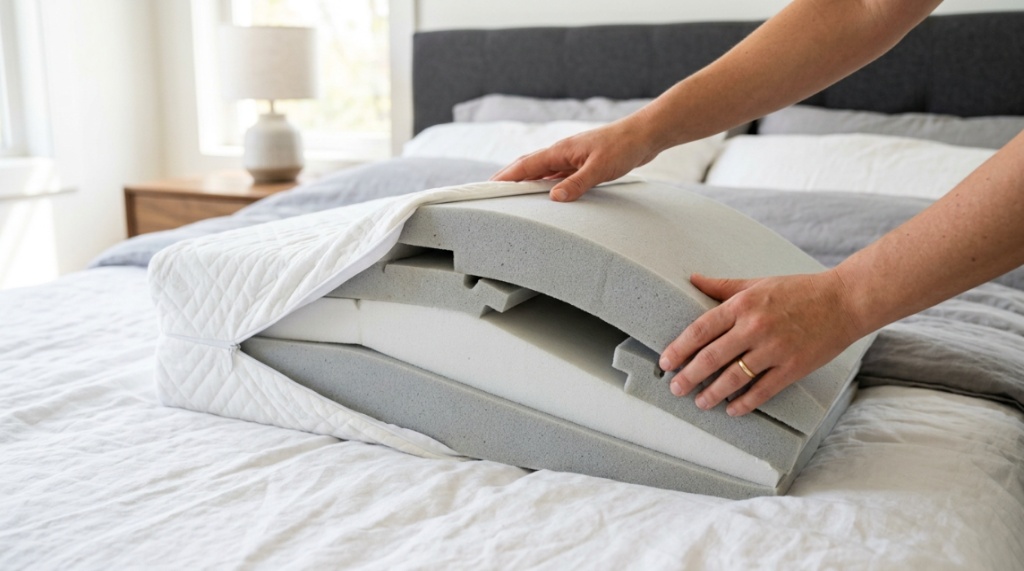
Most adjustable wedges have layered foam pieces that you remove to change the height. Start with all layers in. If the incline is too high, remove the top layer. If it’s too low, add a folded blanket on top of the wedge but under the pillow. The goal is a custom fit, not a standard one.
Using the Incline and Base Layers Correctly
An adjustable wedge pillow setup for sleep relies on how you stack the included foam sections. The large base piece provides the main angle. The smaller top piece acts as a transition to the head. If you invert the small piece, you change the angle from steep to shallow. Always keep the base layer firm; never place the soft foam under the base, as this creates a hammock effect.
When to Use the “Flat” Setting
Some adjustable wedges feature a 180-degree flat setting. Use this only to “rest” during pregnancy if you have low blood pressure or if you are using the wedge as a leg elevation tool for swelling. This mode should not be used for sleep if you bought the wedge for breathing or reflux.
Is It Better to Use a Wedge Pillow on the Floor or Bed?
Use it on your bed. If you place it on the floor, the angle is too steep relative to your body, and the hard floor removes the cushioning your mattress provides. On a bed, the wedge sinks slightly, which makes the angle more ergonomic. The only exception is if your mattress is so soft that the wedge warps in the middle; then a board under the wedge helps.
Effects of a Soft Mattress on the Wedge Angle
A saggy mattress destroys the wedge’s benefit. If the middle of your bed dips, the wedge will bend in the middle, creating a “V” shape. This causes hip and back pain. To fix this, place a thin piece of plywood (cut to wedge dimensions) between the mattress and the wedge to create a flat, stable surface.
Using a Wedge Pillow with an Adjustable Bed
This is the golden combo. If you have an adjustable bed, you do not need to set the wedge at its highest point. Place the wedge flat on the bed and set the bed’s head elevation to 10 degrees. The combination of bed and wedge gives you a perfectly smooth incline without the “sliding” feeling you get from the wedge alone.
What Are the Best Quick Tips for Maintaining Your Wedge Pillow?
To keep your wedge effective, you must maintain its structure. Keep the internal foam dry and fluffed. Most wedge covers are removeable—you need to clean them. A flat, compressed foam means zero support. A good rule is to rotate the wedge head-to-foot every month to prevent permanent indentation.
Cleaning and Keeping the Setup Hygiene
Wedge pillows absorb sweat and skin oils. Remove the outer cover and wash it on a gentle cycle with cold water. Tumble dry low. If the inner foam gets wet, let it air dry on its side for 24 hours. Do not put the foam in the washing machine, as it will break apart.
When to Replace Your Wedge Pillow
If you notice that the foam does not spring back after pressing your hand into it, or if you wake up with a hip indentation, replace it. High-quality adjustable wedges last 2-3 years. If you are using it for acid reflux, and the angle feels like it has flattened, buying a new one is a medical necessity, not a luxury.
Frequently Asked Questions
Can I use an adjustable wedge pillow while sleeping on my stomach?
No. Sleeping on your stomach with a wedge pillow is dangerous for your neck and spine. It forces your neck into a severe rotation. Use the wedge for back sleeping only. If you prefer stomach sleeping, try a flat, extra-thin pillow instead.
Is a wedge pillow good for high blood pressure?
Yes, elevating your head and chest can help reduce blood pressure readings by reducing the pressure on the carotid arteries. A 15-20 degree incline is often recommended. However, always consult with your physician for medical advice regarding hypertension.
How high should a wedge pillow be for vertigo?
For benign paroxysmal positional vertigo (BPPV), a steep incline of 30 to 45 degrees is often suggested to keep particles away from specific inner ear canals. Sleep on your back with a high incline and use a neck roll for support. This angle prevents sudden head movements.
Why does my wedge pillow hurt my tailbone?
This happens when the angle is too steep and your hips are flexed excessively, putting pressure on the coccyx. Place a thick pillow under your thighs/knees to tilt your pelvis forward slightly. If the pain persists, lower the angle of the wedge.
Can a wedge pillow be used under a mattress?
No. Wedges are designed to be on top of the mattress. Putting one under the mattress will not elevate your head properly and will damage the mattress foam. Use the wedge directly on the surface for the correct angle and support.
Should I use a regular pillow on top of the wedge?
Yes, but it should be a thin, contoured pillow, not a thick, puffy one. The wedge provides the elevation, and the regular pillow provides contouring for the neck. If your regular pillow is high-profile, it will negate the benefits of the wedge by bending your neck forward.
Conclusion
Mastering your adjustable wedge pillow isn’t just about lying back; it’s about engineering your sleep surface. By selecting the correct angle for your condition, anchoring the wedge to prevent sliding, and layering your head pillow correctly, you dramatically improve your sleep quality and health outcomes. Remember, comfort during the first three nights is normal, but a persistent pain tells you to adjust. Use the knee pillow trick, keep the structure flat, and prioritize back sleeping. Don’t just use the wedge—set it up properly and let it transform your rest.