










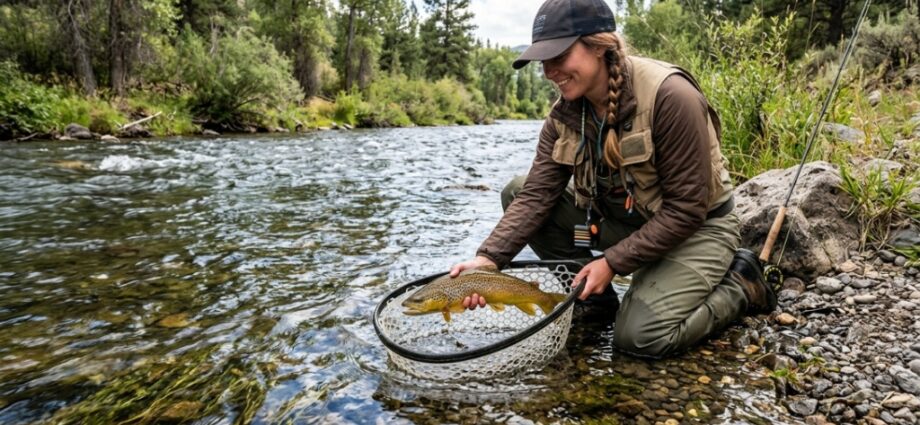
Every time you net a fish with knotted nylon mesh, you strip away its protective slime coating—the biological barrier that shields it from infection, parasites, and disease. A study published in the North American Journal of Fisheries Management found that fish netted in knotted nylon experienced 40% more post-release mortality than fish netted in rubber mesh, primarily due to slime loss and fin damage. If you practice catch and release, your net choice isn’t just a convenience preference — it’s a fish survival decision. A fish-friendly landing net uses materials and designs that minimize harm during the netting, holding, and release process, giving released fish the highest chance of survival. For conservation-minded anglers and fisheries that require it, a catch and release fishing net with rubber mesh, knotless design, and proper sizing is essential equipment.
Catch-and-release fishing works only when released fish actually survive. Research consistently shows that net-related damage — slime removal, fin splits, scale loss, and eye injuries — is a leading preventable cause of post-release mortality. The good news: choosing the right net eliminates most of this damage completely. Rubber mesh, adequate size, shallow bags, and proper handling techniques transform the net from a harm-causing tool into a fish-friendly one. Here’s exactly how to choose a fish-friendly landing net that protects the fish you release.
Why Do Some Fishing Nets Harm Fish?
Nets harm fish through slime coat removal (knotted mesh abrades the protective mucus layer), fin damage (fins tangle and split in mesh), scale loss (rough mesh scrapes scales), and prolonged air exposure (deep bags and tangling extend handling time).
How each mesh type affects fish:
| Mesh Type | Slime Damage | Fin Damage | Hook Tangling | Fish-Friendliness |
|---|---|---|---|---|
| Rubber/silicone | Minimal | Minimal | None | Excellent |
| Knotless nylon (coated) | Low | Low | Moderate | Good |
| Knotless nylon (uncoated) | Moderate | Moderate | Moderate | Acceptable |
| Knotted nylon | High | High | High | Poor |
The slime coat is the fish’s primary defense against infection. When mesh abrades this layer, the fish becomes vulnerable to bacteria and fungus. In cold water, slime regeneration is slow — meaning damage done during netting can persist for weeks, potentially causing delayed mortality that the angler never sees.
What Makes a Net “Fish-Friendly”?
A fish-friendly net minimizes physical contact damage through rubber or silicone mesh, reduces air exposure time through easy unhooking, and prevents fin/scale damage through knotless, smooth-surfaced netting material.
Fish-friendly net characteristics:
- Rubber or silicone mesh: Smooth surface doesn’t abrade slime coat. Non-absorbent, so it doesn’t strip mucus through wicking.
- Knotless design: No knots to catch fins, scrape scales, or split fin rays.
- Appropriate mesh size: Large enough openings that fins don’t wedge through, small enough that the fish can’t push through.
- Adequate net size: Fish isn’t crammed into a too-small space, reducing thrashing and body compression.
- Shallow-to-moderate bag depth: Deep enough to contain but not so deep that reaching the fish takes excessive time and handling.
- Quick unhooking capability: Rubber mesh lets hooks pop free instantly, minimizing handling time.
Why Is Rubber Mesh the Standard for Catch and Release?
Rubber mesh is the catch-and-release standard because it protects the slime coat (smooth, non-absorbent surface), prevents fin damage (no knots or rough edges), allows instant unhooking (hooks slide off), and reduces air exposure time (faster release process).
The science behind rubber mesh superiority:
- Non-absorbent surface: Nylon absorbs moisture (including slime) through capillary action. Rubber doesn’t absorb anything, leaving the slime coat intact.
- Smooth contact: No knots, rough edges, or abrasive surfaces to scrape scales or split fins. The fish contacts only smooth rubber.
- No hook tangling: Hooks bounce off rubber rather than snagging. This means faster unhooking, less handling time, and less air exposure — all reducing stress.
- Maintains shape: Rubber mesh holds the bag shape, preventing fish from becoming tangled in collapsed mesh that wraps around their bodies.
Studies comparing rubber to nylon consistently show lower stress indicators (cortisol levels), less physical damage (scale/slime loss), and lower post-release mortality in fish netted with rubber mesh. For catch-and-release fishing, it’s not optional — it’s the responsible standard.
What Net Size Is Best for Fish Welfare?
A net large enough that the fish isn’t crammed or compressed — with the fish occupying no more than 60–70% of the bag space — minimizes thrashing, body compression, and fin damage that occur when fish are forced into too-small nets.
Size impact on fish welfare:
- Too-small net: Fish is crammed, body compressed, fins forced against mesh, excessive thrashing to escape. Maximum damage potential.
- Correct-size net: Fish has room within the bag, minimal body compression, fins not forced against sides. Lower stress and damage.
- Oversized net: Fish rests comfortably. Minimal compression or forced contact. Best for fish welfare but may be impractical to carry.
For catch-and-release, sizing up one increment from minimum is the best practice. A fish that has room in the net thrashes less, sustains less fin/slime damage, and recovers faster upon release. The slight inconvenience of a larger net is well worth the improved survival of released fish.
How Does Handling Technique Affect Fish Survival?
Handling technique affects survival as much as net choice — minimizing air exposure (under 30 seconds ideal), keeping fish in water during unhooking when possible, and supporting the fish’s body weight all dramatically improve post-release survival.
Fish-friendly handling practices:
- Minimize air exposure: Keep fish in the water as much as possible. If you must lift for a photo, limit air exposure to under 30 seconds. Every second out of water stresses the fish.
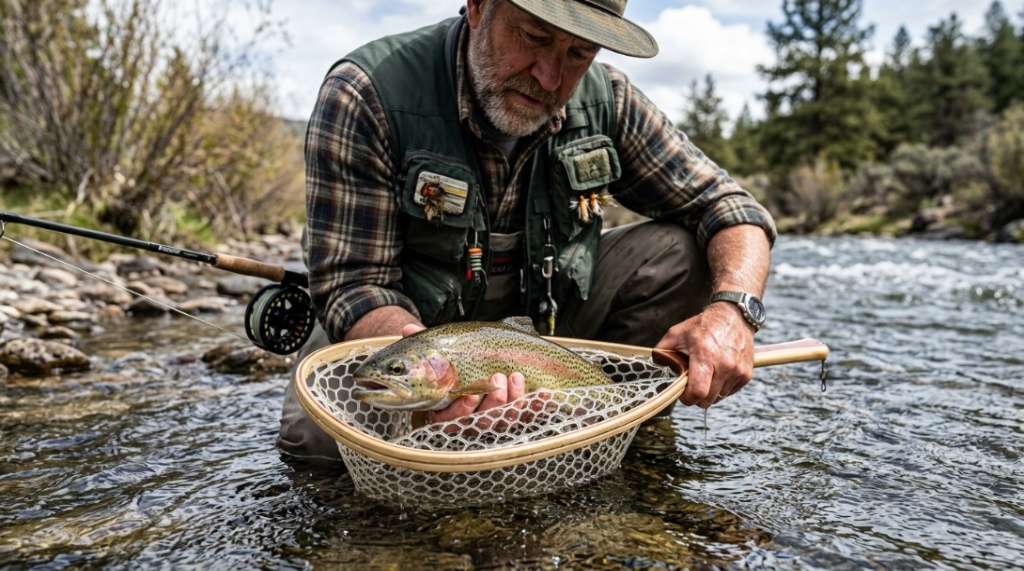
- Unhook in the net: With rubber mesh, unhook while the fish remains in the net in the water. No need to lift the fish to remove hooks.
- Wet your hands: If you must touch the fish, wet your hands first. Dry hands strip slime instantly.
- Support body weight: Never hold a fish vertically by the jaw alone. Support the body with your other hand to prevent organ displacement.
- Revive before release: Hold the fish upright in the water facing current until it swims away under its own power. Don’t just toss it back.
- Use barbless hooks: Combined with rubber mesh, barbless hooks allow instant release without any handling — the best possible scenario for the fish.
Are Fish-Friendly Nets Required by Law in Some Fisheries?
Yes — many fisheries, particularly catch-and-release-only waters, trout streams, and steelhead rivers, mandate rubber or knotless mesh nets. Regulations vary by state and specific water body, so always check local rules.
Common regulatory requirements:
- Catch-and-release-only waters: Often require rubber or knotless mesh to reduce post-release mortality.
- Trophy fisheries: Many managed trophy waters mandate fish-friendly nets to protect breeding-size fish.
- Trout and steelhead waters: Cold-water species with slow slime regeneration often have net material requirements.
- Tournament rules: Many fishing tournaments require rubber mesh nets as a condition of participation.
Even where not legally required, using a fish-friendly net is considered ethical best practice in the angling community. Many fishing guides won’t allow clients to use knotted nylon nets due to the documented harm to fish populations.
How Much Do Fish-Friendly Nets Cost?
Fish-friendly nets with rubber mesh cost $35–$100 — slightly more than basic nylon nets but the difference is modest. The $40–$70 range offers quality rubber mesh nets in sizes suitable for most freshwater catch-and-release fishing.
Price comparison:
- Basic nylon net (not fish-friendly): $15–$30
- Knotless nylon net (moderately fish-friendly): $25–$50
- Rubber mesh net (fish-friendly standard): $35–$80
- Premium rubber mesh with carbon frame: $80–$150
The premium for fish-friendly design is $15–$30 over basic nets — a small investment that dramatically improves fish survival. For anglers who practice catch and release, this is one of the most impactful gear choices for conservation, costing less than a single lure set while potentially saving dozens of fish per season.
Conclusion
Choosing a fish-friendly landing net for catch and release is both an ethical and practical decision. Rubber mesh protects the slime coat, prevents fin damage, eliminates hook tangling, and reduces handling time — all factors that directly improve post-release fish survival. Combined with proper technique (minimize air exposure, unhook in the net, support body weight, revive before release), a fish-friendly net transforms catch-and-release from a hopeful intention into a genuine conservation practice.
Choose rubber or silicone mesh, size the net adequately (fish occupying no more than 60–70% of the bag), and match the net to your target species and fishing position. The modest price premium ($15–$30 over basic nets) pays for itself in fish welfare and angling ethics. If you release fish, your net should be designed to ensure they survive. It’s that simple — and choosing correctly is one of the most meaningful conservation actions any angler can take.
What species do you catch and release most often? Share in the comments — I’ll recommend the specific net size, mesh type, and handling practices that maximize survival for your target fish.
Frequently Asked Questions
What type of net is best for catch and release?
Rubber or silicone mesh nets are best for catch and release. They protect the fish’s slime coat (smooth, non-absorbent surface), prevent fin damage (no knots), and allow instant unhooking (hooks slide off). Studies consistently show lower post-release mortality with rubber mesh compared to nylon.
Does net mesh really affect fish survival?
Yes, significantly. Research shows 40% higher post-release mortality in fish netted with knotted nylon versus rubber mesh, primarily from slime coat removal and fin damage. The slime coat is the fish’s primary defense against infection — removing it through mesh abrasion compromises survival for weeks.
Are rubber mesh nets required for catch and release?
In many fisheries, yes. Catch-and-release-only waters, trout streams, steelhead rivers, and fishing tournaments often mandate rubber or knotless mesh. Even where not legally required, rubber mesh is considered the ethical standard for catch-and-release fishing by the angling community.
How much more do fish-friendly nets cost?
Fish-friendly rubber mesh nets cost $35–$80 — roughly $15–$30 more than basic nylon nets. This modest premium dramatically improves fish survival. The $40–$70 range offers quality options for most freshwater catch-and-release fishing. It’s one of the most impactful conservation investments an angler can make.
How do I handle fish in the net for best survival?
Minimize air exposure (under 30 seconds), unhook in the net while the fish remains in water, wet your hands before touching, support body weight (never hold vertically by jaw alone), and revive facing current until the fish swims away under its own power. Combined with rubber mesh, these practices maximize survival.
What net size is best for fish welfare?
Choose a net where the fish occupies no more than 60–70% of the bag space—large enough that it isn’t crammed or compressed. Oversizing slightly reduces thrashing, body compression, and fin damage. For fish welfare, a slightly too-large net is always better than a slightly too-small one.